Alström Syndrome UK
Support for people with Alström Syndrome and their carers
If you are or think you might be affected by Alström syndrome, we recommend that you read this article about us first.
Alström Syndrome UK has three key aims:
- to help people with Alström Syndrome to provide support for them, their carers and the professionals who are working with them
- to raise awareness amongst both the public and medical professions of Alström Syndrome
- to raise funds to promote research into Alström Syndrome
Emergency Numbers
There are two hospitals expert in Alström Syndrome, Queen Elizabeth Hospital, Birmingham which treats over 16s and Birmingham Children’s Hospital which treats under 16s. If you would like to speak to a medical expert in Alström Syndrome please contact either:
- Dr Tarek Hiwot, Queen Elizabeth Hospital, Birmingham: 07979 127826 or alternatively via the QEH switchboard: 0121 627 2000
- Prof Tim Barrett, Birmingham Children’s Hospital: 0121 333 9999
Meet even rarer - twin girls Katie and Hannah who have been diagnosed with Alström Syndrome
RareConnect
Meet and interact with others who share your condition in a supportive and friendly environment. Find the information and support you need and share your own experiences.
Click on the RareConnect logo to join the Alström Syndrome Community – Connecting Rare Disease Patients Globally.
Sign up today and get involved!
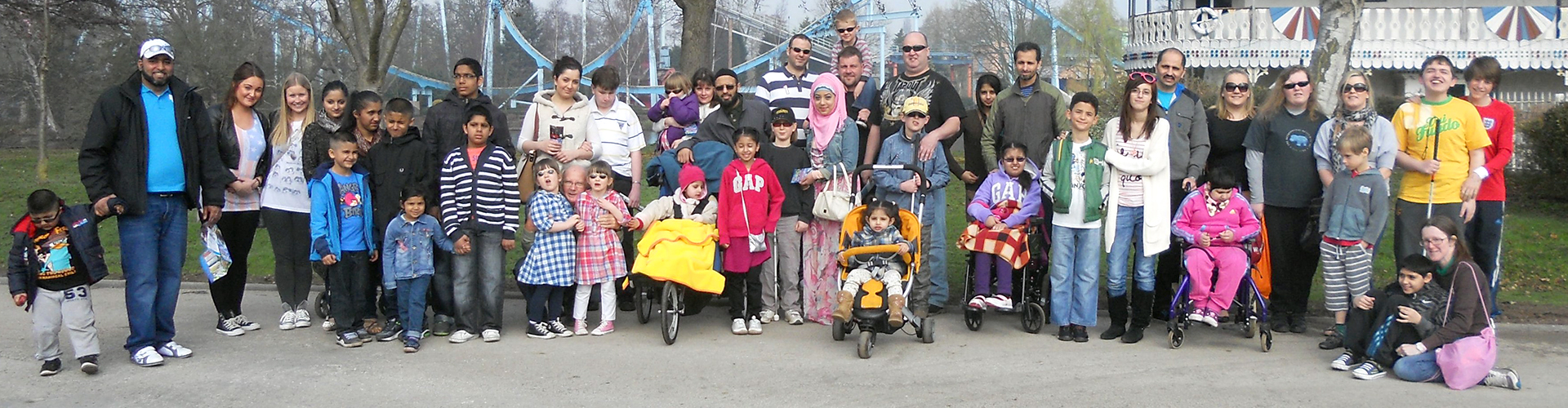
Join ASUK for fun filled activities!
See the stories page for more information…
Raise funds for ASUK
Patients, Doctors and family members cycled 200 miles in aid of ASUK, have a look on the fundraising pages to find out how you can get involved and raise funds for this great cause. With Your Help, We Have Hope
Alström Syndrome Training Course
On behalf of Alström Syndrome UK, HearFirst have designed a one day training course to help raise awareness of Alström Syndrome and to explore the different ways that individuals are affected by the condition. If you believe this could be of interest to either yourself, your colleagues or any of your employees, please download a fact sheet either here in PDF, or here in plain text.
Alström Syndrome Booklet (published 2010)
A guide to greater understanding of this rare condition
For consultants, GPs and other health professionals as well as parents seeking to know more about Alström Syndrome.
Please download a copy here, or alternatively you can request a copy be sent to you by sending an E-mail to Kay Parkinson.
Alström Syndrome UK Annual Report 2011
Alström Syndrome UK are proud to offer anyone interested the ability to download our annual report for 2011. Please get a copy either here as a PDF, or here as a plain text document.
The EURO-WABB Project
An EU Rare Diseases Registry for Wolfram syndrome, Alström syndrome, Bardet-Biedl syndrome and other rare diabetes syndromes.
EURO-WABB
The EURO-WABB Project is a collaboration of doctors, scientists and patient support groups from all over Europe. Within the EU Health Programme 2008-2013 and its call for promoting health through the creation of new registers for rare diseases, EURO-WABB is supported by The EU Directorate General for Health and Consumers (DG-SANCO) via its Executive Agency for Health and Consumers. The overall aim is for this register to be a key instrument to increase knowledge on these rare diseases, improve the lives of affected people through better management, and to develop clinical research.
Wolfram, Alström, Bardet-Biedl (WABB) and other Rare Diabetes Syndromes
WABB syndromes constitute a group of rare, heritable disorders linked by intolerance of the body to glucose. Each of these syndromes affects other parts of the body, including hearing and vision. This Register is mainly directed towards Wolfram syndrome, Alström syndrome and Bardet-Biedl syndrome; however its scope includes some other rarer syndromes including Wolcott-Rallison syndrome and Thiamine-responsive mebaloblastic anaemia, deafness and diabetes syndrome. Long term studies on these syndromes are desperately needed to understand their natural history, relate genetic diagnosis to predicting outcomes, to establish a basis for evidence-based management, and to develop new treatments.
If you would like further information please visit their website www.euro-wabb.org